Beginner Guide
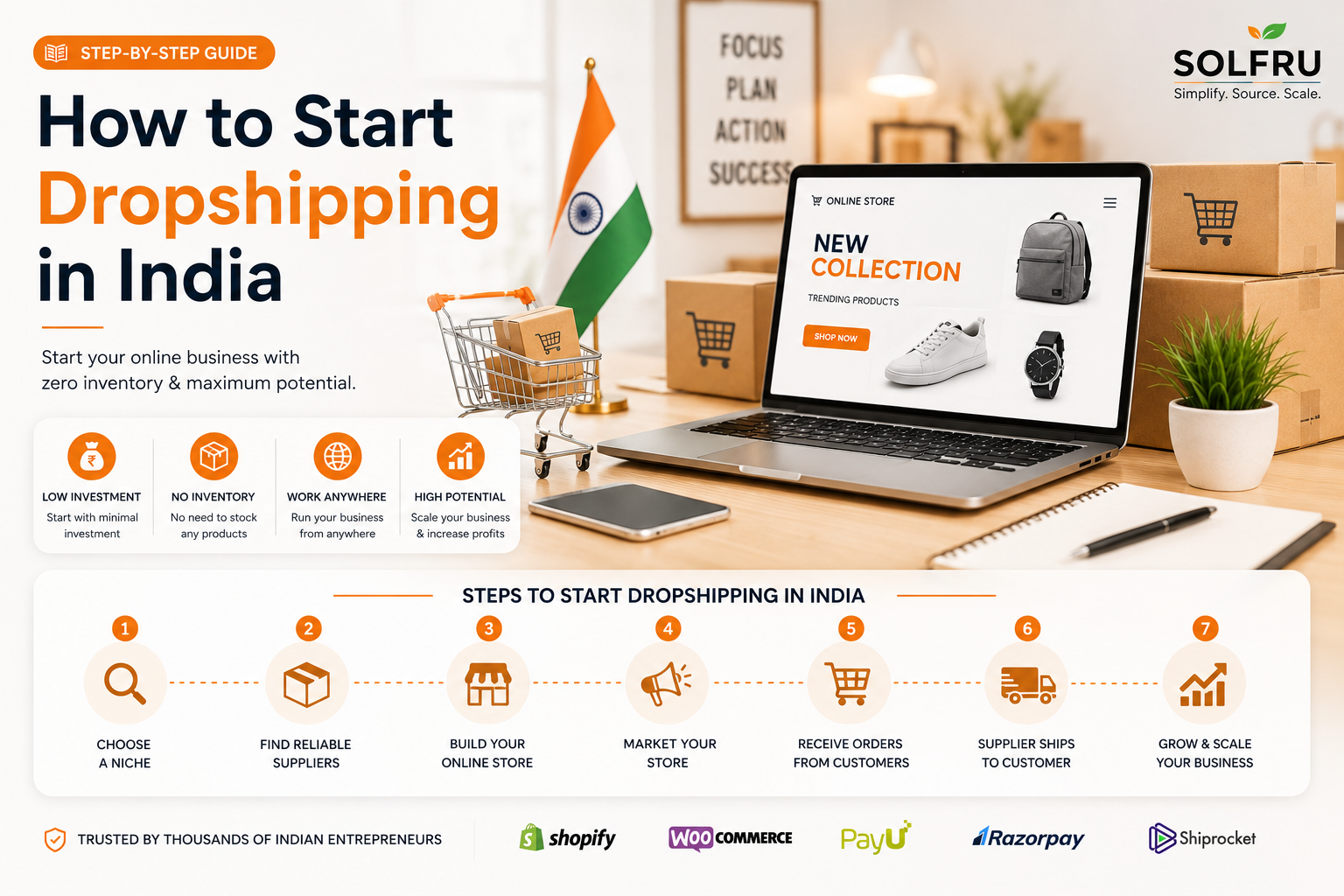
How to Start Dropshipping in India (Step-by-Step Guide)
Learn the complete process of launching your ecommerce business, selecting suppliers, creating your online store, and receiving your first orders.
Read More →

Find verified dropshipping suppliers across India for clothing, fashion, electronics, beauty, home décor, furniture, jewelry, accessories and more. Launch your ecommerce business with fast shipping, COD support and trusted suppliers.
Dropshipping in India is a business model where you sell products online without maintaining inventory. When customers place an order, your trusted supplier packs and ships the product directly to the customer. Solfru helps entrepreneurs discover verified Indian dropshipping suppliers with faster shipping, better profit margins, COD support, and seamless integration with Shopify, WooCommerce, and other ecommerce platforms.

Verified Suppliers
Product Categories
Entrepreneurs
Customer Satisfaction
Whether you're starting your first online store or scaling an established ecommerce business, Solfru helps you discover trusted dropshipping suppliers in India with faster shipping, reliable product quality, competitive wholesale pricing, and dedicated business support. Our mission is to simplify dropshipping in India by connecting entrepreneurs with verified suppliers across multiple product categories.
Every supplier listed on Solfru undergoes a verification process, helping businesses connect with reliable partners that support long-term growth.
Reduce delivery times with suppliers located across major Indian manufacturing and wholesale hubs for quicker customer satisfaction.
Source products directly from trusted suppliers at competitive prices, helping you improve profitability while remaining competitive.
Discover suppliers offering quality products across fashion, electronics, beauty, home décor, furniture, accessories, and more.
Launch your ecommerce store using leading platforms and connect with suppliers that support modern online selling workflows.
Access expert guides, ecommerce insights, and practical strategies designed to help entrepreneurs grow successful dropshipping businesses in India.
Get expert answers to the most frequently asked questions about dropshipping in India, choosing trusted suppliers, shipping, COD, GST, ecommerce platforms, and starting your online business.
Dropshipping in India is an ecommerce business model where you sell products online without purchasing inventory in advance. When a customer places an order, the supplier packs and ships the product directly to the customer, allowing entrepreneurs to operate with lower upfront investment.
The best dropshipping suppliers are businesses that offer reliable product quality, fast shipping, transparent pricing, responsive support, and a wide product selection. Choosing verified suppliers helps improve customer satisfaction and long-term business growth.
Yes. Dropshipping is generally considered a legal ecommerce business model in India when you comply with applicable business, tax, consumer protection, and marketplace regulations. Requirements may vary depending on your business structure and where you sell.
Many entrepreneurs begin with a relatively small budget for a domain, ecommerce platform, marketing, and essential business tools. The exact investment depends on your platform, niche, and advertising strategy.
Yes. Dropshipping is often chosen by beginners because it removes the need to purchase inventory upfront. Success depends on selecting reliable suppliers, building a professional online store, providing good customer service, and effective marketing.
Popular ecommerce platforms include Shopify, WooCommerce, and other modern ecommerce solutions that allow businesses to manage products, payments, orders, and customer communication efficiently.
Indian suppliers can provide faster domestic delivery, easier communication, competitive pricing, and products suited to Indian consumers. This often results in improved customer experience compared to overseas shipping.
Solfru helps entrepreneurs discover trusted dropshipping suppliers in India, compare product categories, learn ecommerce best practices, and make informed supplier decisions through educational resources and supplier discovery tools.
Discover trusted dropshipping suppliers across India for fashion, clothing, electronics, beauty, home décor, furniture, jewellery, kitchenware, automotive accessories, pet products, and more. Compare suppliers based on their product range, shipping capabilities, platform compatibility, and business strengths.
📍 Surat, Gujarat
A trusted supplier offering premium products for ecommerce businesses with fast shipping across India and reliable order fulfillment.
Discover verified dropshipping suppliers across India's fastest-growing product categories. Whether you're starting a fashion brand or selling electronics, home décor, beauty products, or pet supplies, Solfru helps you find trusted suppliers for your ecommerce business.
Clothing, apparel, t-shirts, jeans, dresses, ethnic wear, activewear and accessories.
Explore →Gift Hampers for every Occasions.
Explore →Mobile accessories, gadgets, smart devices, computer accessories and electronics.
Explore →Women & Men accessories and premium collections.
Explore →Kids clothing, toys, baby care products, school essentials and accessories.
Explore →Fitness , gym clothing products.
Explore →Wall décor, lighting, storage, decorative items and home improvement products.
Explore →Kitchenware, cookware, dining accessories and smart kitchen products.
Explore →Filter suppliers by product category, shipping coverage, ecommerce platform and business requirements to discover the best supplier for your online store.
Choose your filters above and click Find Suppliers to browse suppliers that match your business requirements.
Partnering with trusted Indian dropshipping suppliers offers several advantages, including faster domestic delivery, easier communication, competitive wholesale pricing, and products tailored to the Indian market. These benefits can help improve customer satisfaction and support long-term ecommerce growth.
Shipping within India is typically quicker than international fulfillment, helping businesses reduce delivery times and provide a better customer experience.
Buying directly from Indian manufacturers and wholesalers can improve pricing flexibility and support healthier profit margins.
Many Indian suppliers specialize in products that align with local customer preferences, seasonal demand, and regional buying trends.
Working with suppliers in the same country often simplifies communication, business coordination, and issue resolution.
India is home to major manufacturing and wholesale centers known for categories such as apparel, textiles, jewellery, furniture, home décor, and more.
Reliable suppliers, consistent product quality, and dependable fulfillment can help businesses build customer trust and encourage repeat purchases.
Indian suppliers are often chosen because they can simplify domestic order fulfillment, reduce shipping times, improve communication, and provide access to diverse product categories. Selecting the right supplier depends on your niche, business goals, target customers, and operational requirements.
Explore Supplier Directory →
Choosing the right supplier can significantly influence delivery times, customer satisfaction, operational efficiency, and business growth. The table below compares common differences between sourcing from AliExpress and working with trusted Indian dropshipping suppliers.
| Feature | AliExpress | Indian Suppliers |
|---|---|---|
| Shipping Time | Often longer for deliveries to India, depending on seller and shipping method. | Generally faster for domestic orders within India. |
| Customer Communication | Varies by seller and time zone. | Typically easier due to local business hours and communication. |
| COD Support | Usually unavailable. | May be available depending on the supplier and platform. |
| Products for Indian Market | Global product selection. | Often focused on products suited to Indian consumers. |
| Returns & Support | Policies vary by seller. | Support and returns may be simpler when working with domestic suppliers. |
| Wholesale Pricing | Varies by product and seller. | Can be competitive when sourcing directly from Indian manufacturers or wholesalers. |
| Platform Compatibility | Depends on the seller and tools used. | Many suppliers support Shopify, WooCommerce, and other ecommerce workflows. |
| Business Relationship | Often transaction-based. | Potential for long-term supplier partnerships. |
If your primary market is India, domestic suppliers may help reduce shipping times, simplify communication, and improve the overall customer experience. The best choice depends on your product category, business model, and customer expectations.
Browse Indian Suppliers →Use this calculator to estimate your potential profit after product cost, shipping, marketing and transaction fees.
Profit Margin: 0%
Revenue₹0
Total Expenses₹0
Net Profit₹0
Delivery speed plays a major role in customer satisfaction, repeat purchases, and overall ecommerce success. Compare average shipping timelines between Indian suppliers and overseas suppliers to choose the best option for your business.
| Comparison | 🇮🇳 Indian Suppliers | 🌍 Overseas Suppliers |
|---|---|---|
| Metro Cities | 1–3 Days | 7–20 Days |
| Tier-2 & Tier-3 Cities | 2–5 Days | 10–25 Days |
| Order Processing | Same Day / Next Day | 2–5 Days |
| Express Shipping | Available | Limited |
| Cash on Delivery | Available | Usually Not Available |
| Easy Returns | Simple | Complex |
| Customer Satisfaction | Higher due to faster delivery | Can vary depending on shipping time |
Local suppliers generally deliver within a few business days, helping improve the customer experience.
Domestic logistics can reduce customs-related delays and simplify tracking for customers.
Quicker delivery and easier returns often contribute to stronger customer trust and repeat business.
Shipping times vary depending on supplier, courier partner, product availability, destination, and seasonal demand. Always confirm estimated delivery times directly with your supplier before advertising shipping commitments.
Cash on Delivery (COD) remains a popular payment option for many online shoppers in India. Depending on the supplier, courier partner, and serviceable location, offering COD can help increase customer confidence and improve conversion rates.
Many customers feel more comfortable paying when their order arrives, especially for first-time purchases.
For some businesses and product categories, COD can encourage more shoppers to complete their purchases.
COD availability depends on the courier network and whether the customer's PIN code is serviceable.
Providing multiple payment methods gives customers more flexibility when placing an order.
Working with reliable suppliers and logistics partners can help streamline COD order processing and returns.
Many Indian suppliers support domestic shipping options, though COD availability varies by supplier and courier.
COD availability depends on the supplier, courier partner, destination PIN code, and product category. Always confirm current COD support before promoting it to customers.
Understanding Goods and Services Tax (GST) is an important part of running an ecommerce business in India. GST requirements vary depending on your business structure, turnover, product category, and applicable tax laws. This guide provides a general overview to help beginners understand the basics.
Decide whether you'll operate as a sole proprietorship, partnership, LLP, or private limited company based on your business needs.
Whether GST registration is required depends on factors such as turnover, business activities, and applicable GST rules.
GST rates differ across product categories. Verify the applicable tax rate for the products you plan to sell.
Keep proper invoices and transaction records to support tax compliance and business accounting.
If registered for GST, file returns according to the applicable schedule and regulatory requirements.
Choose your business structure.
Determine whether GST registration applies to your business.
Issue compliant invoices where required.
Maintain sales and purchase records.
File GST returns on time, if applicable.
GST laws and compliance requirements can change over time. This information is intended as a general guide and should not be considered legal or tax advice. Always verify the latest regulations and consult a qualified tax professional for guidance specific to your business.
Starting a dropshipping business doesn't have to be complicated. Follow this beginner-friendly roadmap to move from idea to your first customer with confidence.
Research customer demand, competition, and product trends. Focus on a niche that aligns with your business goals and target audience.
Compare suppliers based on product quality, shipping options, pricing, communication, and platform compatibility before making a decision.
Build your ecommerce website using platforms such as Shopify or WooCommerce and organize your products with clear descriptions and images.
Add products with accurate information, pricing, and inventory details. Review listings before publishing them.
Calculate selling prices by considering product cost, shipping, marketplace fees, taxes, and your desired profit margin.
Test checkout, payment methods, shipping settings, and customer communication before opening your store to the public.
Promote your business using SEO, content marketing, social media, email marketing, and paid advertising where appropriate.
Track traffic, conversions, customer feedback, and product performance to identify opportunities for continuous improvement.
Start with a focused product range instead of listing hundreds of products.
Work with reliable suppliers and verify product quality whenever possible.
Provide clear shipping and return policies to build customer trust.
Monitor your store's performance and refine your strategy over time.
Building a successful dropshipping business usually takes consistent testing, learning, and optimization. Focus on providing value to customers and improving your operations over time.
Whether you're just starting or managing a growing ecommerce business, choose the membership that best matches your needs.
Dropshipping is an ecommerce fulfillment model where a retailer sells products without keeping inventory. When a customer places an order, the retailer forwards the order to a supplier, who prepares and ships the product directly to the customer.
A customer visits your online store, selects a product, and completes the purchase.
You forward the customer's order details to your selected dropshipping supplier.
The supplier prepares the product and hands it over to the shipping partner.
The courier delivers the order directly to the customer while you manage the customer relationship.
Since inventory is managed by suppliers, businesses can often begin without purchasing stock upfront.
Products are generally shipped directly from the supplier, reducing warehouse requirements.
Businesses can usually offer a broad range of products without storing physical inventory.
As your store grows, reliable suppliers can help support increasing order volumes.
While dropshipping can reduce inventory costs, success depends on factors such as supplier reliability, product quality, pricing strategy, customer service, and effective marketing.
India is home to several manufacturing and wholesale hubs serving different product categories. Explore these major business locations to identify suppliers that align with your product niche and logistics requirements.
Fashion, Electronics, Home Products, Wholesale Markets
Explore Suppliers →Fashion, Beauty, Lifestyle & Consumer Products
Explore Suppliers →Sarees, Clothing, Apparel & Textile Manufacturers
Explore Suppliers →Jewellery, Handicrafts, Home Décor & Fashion
Explore Suppliers →Winter Wear, Hosiery & Knitwear Manufacturers
Explore Suppliers →T-Shirts, Garments & Export Clothing
Explore Suppliers →Electronics, Lifestyle, Startup & Tech Products
Explore Suppliers →Electronics, Mobile Accessories & Consumer Goods
Explore Suppliers →Metal Handicrafts, Home Décor & Gift Items
Explore Suppliers →Hardware, Industrial Products & Kitchenware
Explore Suppliers →Textile, Apparel, Home & Industrial Products
Explore Suppliers →Automotive, Lifestyle & Consumer Products
Explore Suppliers →Jewellery, Fashion, Electronics & Wholesale Markets
Explore Suppliers →Supplier availability, product categories, shipping options, and business services vary by city and individual supplier. Compare multiple suppliers and verify shipping timelines, product quality, pricing, and policies before establishing a business relationship.
India's ecommerce ecosystem continues to expand, supported by rising internet usage, digital payments, logistics improvements, and increasing online shopping adoption across metro as well as Tier-2 and Tier-3 cities.
Estimated market size in 2026.
Expected annual growth through 2031.
Forecast growth for the Indian dropshipping market.
Estimated market size during 2025.
Online shopping growth is increasingly driven by non-metro cities.
UPI and prepaid payments continue to support ecommerce expansion.
Market estimates vary across research organizations because of differences in methodology, market definitions, and reporting periods. Always refer to the latest industry reports when making business decisions.
Hear what entrepreneurs say about their experience with Solfru.
"Solfru made it much easier to discover suppliers for our online store. The supplier directory saved us significant research time."
"The educational guides helped us better understand supplier selection and ecommerce operations."
"A clean platform with useful resources for businesses looking to compare suppliers and learn ecommerce."
Prefer learning visually? Watch our expert videos covering dropshipping, supplier selection, ecommerce strategies, Shopify, WooCommerce, product sourcing, and online business growth in India.
Learn how to identify suppliers that fit your product category, shipping needs, and business goals.
Discover practical tips for launching an ecommerce store using platforms such as Shopify and WooCommerce.
Explore strategies for marketing, customer service, and long-term business growth.
Subscribe for new videos featuring supplier guides, ecommerce tutorials, industry insights, and practical business tips designed to help entrepreneurs make informed decisions.
Stay updated with expert insights, supplier recommendations, ecommerce strategies, Shopify tutorials, WooCommerce guides, marketing tips, and industry trends designed to help entrepreneurs grow successful online businesses.
Learn the complete process of launching your ecommerce business, selecting suppliers, creating your online store, and receiving your first orders.
Read More →
Compare trusted suppliers across fashion, electronics, beauty, home décor, accessories, and other popular ecommerce categories.
Read More →
Understand how Shopify works with dropshipping suppliers and explore practical tips for launching and managing an online store.
Read More →
Learn how to build a WordPress ecommerce store, connect suppliers, and manage products using WooCommerce.
Read More →Explore popular ecommerce niches and product categories that align with current consumer demand and business goals.
Read More →
Discover practical marketing approaches, customer acquisition ideas, and growth strategies for ecommerce businesses.
Read More →Find answers to the most frequently asked questions about dropshipping suppliers in India, ecommerce, supplier selection, shipping, GST, and starting an online business.
Dropshipping is an ecommerce fulfillment model where a retailer sells products without keeping inventory. When an order is placed, the retailer forwards it to a supplier, who prepares and ships the product directly to the customer.
Dropshipping suppliers are businesses that store inventory, process customer orders, pack products, and arrange shipping on behalf of online sellers.
Compare suppliers based on product quality, communication, shipping options, return policies, business documentation, customer support, and product categories before making a decision.
In many dropshipping arrangements, sellers do not purchase inventory upfront. Products are typically purchased from the supplier after a customer places an order.
Popular categories include fashion, beauty, electronics, home décor, kitchen products, accessories, fitness items, pet supplies, toys, and lifestyle products. Product demand can change over time.
Yes. Shopify can be used to build an ecommerce store that works with compatible suppliers and fulfillment solutions, depending on your chosen workflow.
Yes. WooCommerce offers flexibility for creating WordPress-based online stores and can integrate with various dropshipping plugins and supplier workflows.
No. COD availability depends on the individual supplier, courier partner, delivery location, and product category. Always confirm payment options before partnering with a supplier.
GST requirements depend on your business structure, turnover, products, and applicable regulations. Consider consulting a qualified tax professional for guidance specific to your business.
Evaluate suppliers based on product quality, communication, pricing, shipping options, return policies, order processing, business credentials, and customer support. Testing products before scaling your business can also be beneficial.
Delivery times vary depending on the supplier, courier service, inventory availability, destination, and shipping method. Always confirm estimated delivery timelines with your supplier before listing products.
Many businesses sell through their own ecommerce websites as well as online marketplaces. Platform policies, seller requirements, and supplier compatibility should be reviewed before you begin.
Return and refund policies differ between suppliers. Before partnering with any supplier, review their return window, damaged product policy, replacement process, and refund terms.
Consider product quality, pricing, communication, shipping coverage, return policy, business documentation, customer support, order processing, and overall reliability before making a decision.
Yes. Many ecommerce businesses source products from multiple suppliers to expand their catalog and reduce dependency on a single supplier. Managing inventory availability and order fulfillment across suppliers is important.
The right platform depends on your budget, technical skills, customization needs, and business goals. Popular choices include hosted ecommerce platforms and self-hosted solutions such as WordPress with WooCommerce.
Most suppliers provide contact options such as email, phone, website inquiry forms, or messaging channels. Ask questions about products, shipping, pricing, order processing, and support before partnering.
Some suppliers support international fulfillment while others focus primarily on domestic shipping. International availability depends on the supplier, destination country, customs requirements, and courier partnerships.
Compare suppliers based on product range, quality, pricing, shipping options, customer support, order processing, return policy, communication, and overall business reputation.
Supplier directories, industry networks, trade events, manufacturer websites, and ecommerce platforms can help you identify potential suppliers. Always verify supplier credentials, product quality, and business policies before entering into a partnership.
Here's a quick summary of the most important points covered in this guide to help you make informed decisions when choosing dropshipping suppliers and building your ecommerce business.
Compare suppliers based on product quality, communication, shipping options, pricing, business credentials, and customer support before making a decision.
Delivery timelines, courier partners, and fulfillment capabilities vary by supplier and destination, so review shipping details carefully.
Confirm available payment options, including prepaid and Cash on Delivery (where offered), before listing products.
Review return policies, replacement procedures, order processing times, and support channels before partnering with a supplier.
Choose an ecommerce platform that matches your business goals, technical requirements, and preferred supplier workflow.
Sustainable ecommerce growth depends on supplier relationships, customer service, marketing, pricing strategy, and continuous improvement.
Building a successful ecommerce business takes planning, research, and consistent execution. By carefully evaluating suppliers, understanding fulfillment processes, and focusing on customer experience, you can create a stronger foundation for long-term business growth.